
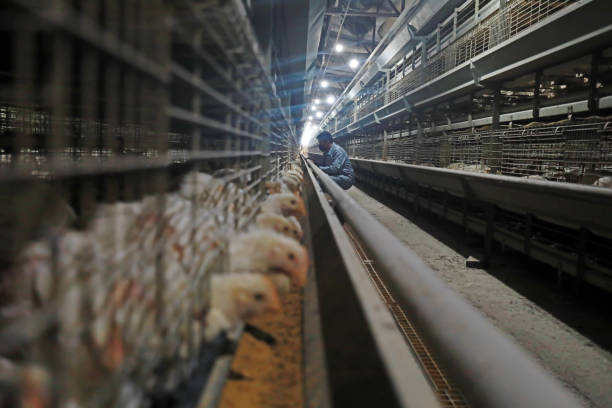
High Quality Broiler Chicken Cages for Sale
If you’re in the broiler business, you know that the market waits for no one. Every day you spend managing inefficient housing is a day you’re leaving money on the table. Whether you’re raising 5,000 birds or 50,000, the equipment you choose sets the ceiling for your farm’s performance. We’ve been designing and manufacturing top-tier poultry equipment since 2012, and we’ve seen firsthand how the right cage system can transform a struggling operation into a profit machine. We’re talking about faster growth rates, lower mortality, and a whole lot less stress for you and your team. In this article, we’re going to break down everything you need to know about broiler chicken cages—why they work, what to look for, and how to pick the perfect setup for your farm.
Why Switch to Cages for Broiler Production?
For decades, the standard way to raise broilers was on the floor—the deep litter system. And for small farms, that can still work. But as you scale up, floor raising starts to show its cracks. You’ve got birds trampling feed, poop piling up in the corners, and a constant battle against disease and parasites. When you switch to a cage system, you’re essentially putting your birds in a controlled environment where everything is optimized .
First off, think about space. With cages, particularly H-type systems, you’re building upwards, not outwards. This lets you pack more birds into the same square footage, which is a huge advantage if land is expensive or limited in your area . Some farmers see a 50% to 100% increase in bird capacity per square meter after switching to cages . But it’s not just about cramming them in; it’s about efficiency. Cages lift the birds above their waste, which drastically cuts down on ammonia fumes and keeps them cleaner and healthier . Healthier birds eat better, convert feed more efficiently, and hit that market weight faster. That’s the kind of math that pays off.
The Nuts and Bolts of a Quality Broiler Cage System
So, what actually makes a good broiler cage? It starts with the materials. You want cages made from hot-dip galvanized steel. This isn’t just paint; it’s a thick zinc coating that gets baked onto the metal, protecting it from rust and the corrosive effects of chicken manure and daily washing . A well-made cage should last you 15 to 20 years with minimal fuss .
Next, look at the design. Broiler cages are usually arranged in 3 or 4 tiers to maximize vertical space . Each cell is sized to hold a specific number of birds—common configurations hold anywhere from 10 to 26 birds per cell, depending on the target weight you’re raising to . For example, if you’re raising birds to about 2.5 kg, you’ll want to ensure the density is around 490 to 500 cm² per bird to give them enough room to grow comfortably without crowding . The doors should slide smoothly for easy access when you need to catch birds for market, and the floor mesh needs to be sturdy enough to support their weight without sagging .
Automation: Taking the Grunt Work Out of Growing Birds
Here’s where things get really interesting. A set of cages is a great start, but when you hook them up to automatic systems, that’s when you unlock the real potential of your farm. We’re talking about fully integrated systems that handle the three biggest chores: feeding, drinking, and cleaning .
An automatic feeding system runs on a track or cable, delivering a precise ration of feed to every trough along the line. This ensures every bird gets exactly what it needs, when it needs it, with zero waste. It also means you’re not hauling bags of feed around the farm—the machine does the heavy lifting . The watering system is just as critical. Nipple drinkers with built-in pressure regulators deliver clean, fresh water on demand, keeping the litter drier and reducing the risk of wet, smelly conditions that lead to disease .
Then there’s the manure management system. This is a game-changer for your birds’ health and your own sanity. High-quality cages come with manure belts running under each tier. These belts automatically scrape the waste away and carry it out of the house to a collection area, often several times a day . This keeps the air inside the house fresh and reduces the fly population, which means a better environment for the birds and a much more pleasant place for you to work. And if you really want to go all-in, you can add an environmental control system that automatically manages fans, heaters, and cooling pads to keep the temperature and humidity perfect, 24/7 .
What to Consider Before You Buy
Before you pull the trigger on a new system, you need to have a clear picture of your farm. Not all cages are created equal, and the best one for you depends on your specific goals. Ask yourself a few questions: What’s the target weight for my birds? How many birds do I want to house per batch? What are the exact dimensions of my chicken house—length, width, and height at the eaves ?
A good supplier will ask you these questions before they ever quote you a price. We don’t believe in one-size-fits-all solutions. We’ll work with you to design a layout that fits your space and your budget. Whether you need a simple A-type starter cage for young chicks or a high-density H-type system for heavy broilers, we’ve got the experience to make it happen .
We know that switching to cages is a big decision, and you want to get it right the first time. That’s why we’re here to help you every step of the way, from the initial design to on-site installation guidance. If you’re ready to stop working so hard and start seeing better results, reach out to us. Contact Livi Machinery today for a free farm consultation and quote—let’s build a system that works for you.
Frequently Asked Questions
Q1: What’s the difference between A-type and H-type broiler cages?
The main difference is in the layout and capacity. A-type cages are often simpler and might be used for smaller operations or for brooding young chicks . H-type cages are a more modern, high-density system where the cages are stacked vertically in rows, supported by a structural “H” frame. They maximize space usage and are the standard for large-scale, fully automated farms .
Q2: How many birds can I fit in a single broiler cage?
It depends on the specific cage model and the final weight of your broilers. For example, a common H-type cage cell measuring 1400*700*400mm might hold 10 birds destined for a 2.5kg market weight . Larger cells, like 1250*1050*600mm, can hold up to 26 birds . Your equipment supplier should help you calculate the correct density (e.g., cm² per bird) to ensure bird welfare and optimal growth.
Q3: Is it healthier for broilers to be raised in cages?
When managed correctly, yes. Cage systems with automated manure belts keep birds elevated above their waste, dramatically reducing their exposure to harmful ammonia and parasites . This leads to cleaner birds, lower mortality rates, and a reduced need for medications .
Q4: How long do galvanized steel chicken cages last?
High-quality cages that use a hot-dip galvanizing process are incredibly durable. You can expect them to last anywhere from 15 to 20 years, even with daily use and regular cleaning, making them a solid long-term investment .
Q5: Can I install an automatic feeding system in my existing house?
Absolutely. Automatic feeding systems are designed to be retrofitted into most existing poultry houses. During a consultation, we’ll assess your current setup—including the dimensions and structure of your house—to design a system that integrates seamlessly with your new or existing cages .
Q6: What kind of maintenance do these automatic systems need?
Routine maintenance is fairly simple. It mainly involves periodic checks of the motors, gearboxes, and belts to ensure everything is running smoothly. Keeping sensors clean is also important for systems with environmental controls. The beauty of automation is that it replaces daily grunt work with occasional technical checks.
Q7: Do I need a special chicken house for cage systems?
While you can install cages in many existing houses, the ideal setup is a house with good insulation and the height to accommodate 3 or 4-tier systems. If you’re building a new farm, an environmentally controlled closed house paired with automatic cages is the ultimate setup for maximizing productivity and bird health .