
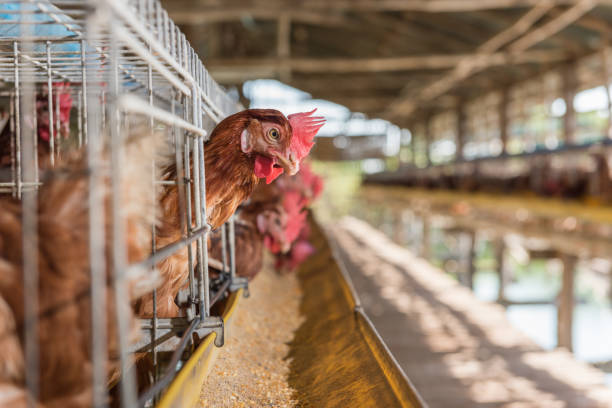
50000 Layers Poultry Farm in Kenya: H Type Automatic Layer Cage Solution
For a 50000 Layers Poultry Farm in Kenya, a fully automatic H type layer cage system is usually the most efficient solution because it saves land, reduces labor, improves egg collection efficiency, and supports better manure and climate management. For commercial farms in Kenya, especially projects near Nairobi, Nakuru, Eldoret, Thika, or other egg consumption and distribution areas, Livi Machinery recommends a customized H type layer battery cage system with automatic feeding, nipple drinking, belt manure removal, egg collection, ventilation, cooling pads, and intelligent control.
Kenya’s poultry farm design should not copy a standard layout from another country. The country has diverse climate conditions, from cooler highland areas to hotter and more humid regions. Kenya’s average annual temperature is about 24.3°C, and rainfall is concentrated mainly from March to June and October to December, so ventilation, drainage, roof insulation, and power backup should be considered carefully in farm planning.
Why Is H Type Layer Cage Suitable for 50,000 Layers?
A 50,000-bird layer project is already a commercial-scale egg production farm. Compared with traditional deep litter or low-density cage systems, the H type layer cage system uses vertical space more effectively, which is important for Kenyan investors who want to control land and construction costs.
Livi Machinery’s H type layer cage is designed for high-density and intensive layer farming. According to Livi’s layer cage system catalogue, H type layer equipment can be configured in 3-tier, 4-tier, 5-tier, or 6-tier models, with different bird capacities per set. The system supports automatic feeding, drinking, egg collection, manure removal, and environmental control.
For a 50,000-layer farm, common design options include:
| Cage Model Option | Birds per Set | Approx. Sets for 50,000 Layers | Suitable Farm Type |
|---|---|---|---|
| H Type 4-tier 4-door | 192 birds/set | About 261 sets | Medium automation, easier maintenance |
| H Type 5-tier 4-door | 240 birds/set | About 209 sets | Balanced land saving and operation |
| H Type 6-tier 4-door | 288 birds/set | About 174 sets | Higher density, suitable for larger automated farms |
The final cage quantity should be confirmed after checking house width, length, aisle design, manure belt layout, egg collection direction, and local construction conditions.
What Equipment Is Needed for a 50000 Layers Poultry Farm in Kenya?
A complete 50,000-layer farm is not only a cage purchase. The equipment must work as one integrated production system. For Kenyan customers, Livi Machinery usually recommends the following configuration:
| System | Function | Why It Matters in Kenya |
| H type layer battery cage | Houses layers in high-density rows | Saves land and supports future expansion |
| Automatic feeding system | Delivers feed evenly to each tier | Reduces feed waste and labor dependency |
| Nipple drinking system | Supplies clean water to each cage row | Helps keep manure drier and reduces leakage |
| Belt manure removal system | Removes manure regularly from each tier | Improves air quality and farm hygiene |
| Automatic egg collection system | Transfers eggs from cage rows to collection area | Reduces manual handling and egg damage |
| Ventilation and cooling system | Controls heat, humidity, and air exchange | Important for hot or humid regions |
| Intelligent control cabinet | Manages fans, feeding, lighting, water, and alarms | Supports stable operation with fewer workers |
| Feed silo and conveying system | Stores and transfers bulk feed | Useful for farms purchasing feed in large volume |
Poultry house climate has a direct influence on bird health, feed efficiency, and egg production. Poultry Hub Australia notes that poultry house climate includes temperature, humidity, air composition, air movement, and light, and that unsuitable climate conditions can increase respiratory, digestive, and behavioral problems.
What Should Be Considered Before Building the Chicken House?
For a 50,000-layer farm in Kenya, the chicken house should be designed around climate, electricity, logistics, and future growth.
First, ventilation should match the region. In highland areas such as parts of Nakuru, Eldoret, and Kiambu, temperature may be more moderate, but humidity and night temperature changes should still be managed. In warmer areas, cooling pads, exhaust fans, air inlets, and roof insulation become more important.
Second, drainage should be included in the site plan. Kenya’s rainfall pattern includes long and short wet seasons, so the farm should have elevated foundations, drainage channels, and proper road access for feed trucks and egg collection vehicles.
Third, power backup is necessary for automated poultry farms. Feeding, ventilation, lighting, water pressure, and egg collection all depend on stable electricity. A generator or solar-hybrid backup can protect the flock during outages and reduce operational risk.
Fourth, expansion should be planned from the beginning. Many investors start with 50,000 layers and later expand to 80,000 or 100,000 birds. Livi Machinery can reserve space for additional cage rows, feed silos, manure transfer lines, and egg collection upgrades during the first design stage.
How Can Automation Improve Egg Farm Management?
Automation brings measurable advantages to large layer farms. For a 50,000-layer project, manual feeding and egg collection require many workers and create management inconsistency. Automatic systems help the farm standardize daily operations.
Key benefits include:
- More uniform feeding across cage rows and tiers
- Lower labor intensity for workers
- Less direct human contact with birds
- Cleaner manure handling and better air quality
- Faster egg collection during peak laying period
- Lower risk of egg cracking during manual handling
- Easier management through control panels and sensors
For egg handling, Livi’s automatic egg collection system can be configured with belts, egg claws, elevator collection, and central egg conveying. The catalogue shows egg conveyor capacity options ranging from 15,000 to 65,000 eggs per hour, depending on conveyor width and configuration.
Recommended Layout Concept for 50,000 Layers in Kenya
A practical layout for a 50,000-layer farm may include one or two layer houses, depending on land size and budget. A one-house design can reduce construction duplication, while a two-house design may improve batch management and biosecurity.
A typical planning direction may include:
| Design Item | Recommended Direction |
| Cage type | H type 4-tier, 5-tier, or 6-tier layer cage |
| Capacity | 50,000 laying hens |
| House structure | Steel structure or locally built house with equipment-compatible layout |
| Feeding | Silo + automatic conveying + cage feeding trolley/system |
| Drinking | Nipple drinking line with pressure regulator |
| Manure | Belt manure removal inside cage rows, optional outside manure conveyor |
| Egg collection | Longitudinal egg belt + elevator or central egg collection line |
| Climate | Exhaust fans, air inlets, cooling pads, lighting, control cabinet |
| Expansion | Reserve land and utility interfaces for future cage rows |
For hot periods, the house should maintain enough air speed and fresh air exchange. Hendrix Genetics notes that the optimal environmental house temperature for laying hens is around 25°C and that heat stress becomes a risk beyond 30°C, especially in tropical environments.
Why Work with Livi Machinery for a Kenya Layer Farm Project?
Livi Machinery provides more than poultry cages. For a 50,000-layer project in Kenya, the company can support the customer from early planning to equipment operation.
The service process usually includes:
- Understanding the customer’s land size, target capacity, budget, and expansion plan.
- Providing a customized poultry house layout and equipment configuration.
- Matching cage model, feeding, drinking, manure removal, egg collection, and ventilation systems.
- Arranging equipment production, packing, and transportation.
- Offering installation guidance and after-sales support.
- Helping the farm optimize daily operation after equipment installation.
This one-stop approach is especially useful for investors who are building a modern layer farm for the first time. Instead of buying cages, fans, drinkers, and egg belts from different suppliers, the customer receives a coordinated system designed for the same house layout.
FAQ
1. What cage type is better for 50,000 layers in Kenya?
For 50,000 layers, H type layer cages are usually recommended because they save land, support higher automation, and are suitable for commercial egg production.
2. How many H type cage sets are needed for 50,000 layers?
It depends on the cage model. For example, a 5-tier 4-door H type cage with 240 birds per set needs about 209 sets. The final quantity should be adjusted according to the poultry house layout.
3. Can the farm be expanded later?
Yes. Livi Machinery can design the first-stage project with reserved space for future expansion to 80,000 or 100,000 layers.
4. Is automatic egg collection necessary?
For a 50,000-layer farm, automatic egg collection is strongly recommended. It reduces labor, improves collection speed, and helps lower egg damage caused by manual handling.
5. What should Kenyan farmers pay attention to before installation?
Farmers should confirm land size, road access, water supply, power supply, drainage, house orientation, and whether backup electricity is available for ventilation and feeding systems.