
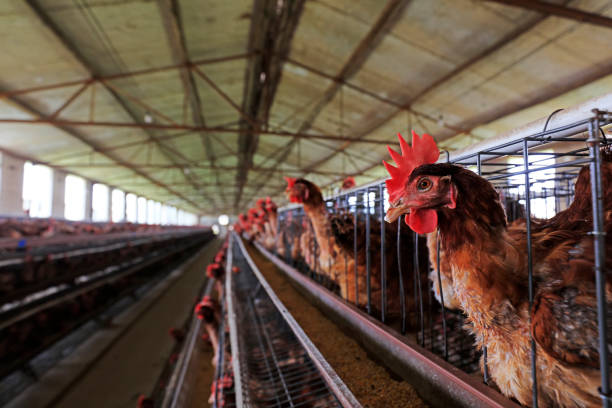
30,000 Layer Chicken Farm in Algeria with H Type Automatic Cage System
What Is the Recommended Solution for 30,000 Layers in Algeria?
For a 30,000 layer chicken farm in Algeria, Livi Machinery recommends an H type fully automatic layer battery cage system combined with automatic feeding, nipple drinking, belt manure removal, automatic egg collection and environmental control.
Using the 4-tier, 2-door H type layer cage with a nominal capacity of 144 birds per set, approximately 209 cage sets are required to provide nominal cage capacity for at least 30,000 layers:
30,000 ÷ 144 = 208.33 → approximately 209 sets
This is a planning calculation rather than a final equipment bill. The actual cage quantity and row arrangement should be finalized according to the chicken house dimensions, aisle arrangement, equipment end space and the customer’s required stocking capacity.
Livi’s published H-type specifications list the 4-tier 2-door model at 144 birds/set with a cage specification of 1200 × 625 × 480 mm. The same system can integrate automatic feeding, drinking, manure removal, egg collection and environmental control.
For Algeria, special attention should also be paid to ventilation, cooling, insulation and reliable environmental control, especially where high summer temperatures may affect layer performance.
Project Overview Table
| Project Item | Recommended Solution |
|---|---|
| Country | Algeria |
| Poultry Type | Commercial Layers |
| Planned Capacity | 30,000 birds |
| Cage Type | H Type Layer Battery Cage |
| Recommended Model | 4-Tier, 2-Door |
| Nominal Capacity | 144 birds/set |
| Preliminary Cage Quantity | Approx. 209 sets |
| Cage Specification | 1200 × 625 × 480 mm |
| Feeding | Automatic feeding system |
| Drinking | Automatic nipple drinking system |
| Manure Management | Automatic manure removal belts |
| Egg Handling | Automatic egg collection |
| Climate Management | Fans + cooling pads + environmental controller |
| House Layout | Customized according to site and house dimensions |
| Service | Farm planning, equipment quotation, shipping and installation guidance |
Customer Background
The project is planned as a 30,000-bird commercial layer farm in Algeria. At this capacity, the customer needs more than cages alone. The farm needs to integrate bird housing, feed distribution, drinking water, manure handling, egg collection and climate management into one coordinated system.
For a commercial operation of this scale, excessive dependence on manual labor can create bottlenecks. Feeding thousands of birds uniformly, removing manure regularly and moving tens of thousands of eggs are repetitive operations that are more suitable for mechanization.
The design objective is therefore to create a high-density and scalable layer farm that makes better use of chicken-house space while reducing repetitive manual operations.
What Challenges Should a 30,000-Bird Farm Solve?
1. Efficient use of chicken-house space
A 30,000-layer project requires considerable housing capacity. Using a low-density layout can increase building footprint and associated construction requirements.
An H-type stacked cage system increases vertical utilization of the poultry house and is therefore particularly relevant to commercial farms where capacity per house is important.
2. Feeding 30,000 birds consistently
Manual feed distribution becomes increasingly difficult as farm capacity grows. Differences in feeding time and feed distribution can complicate flock management.
An automatic feeding system moves feed along the cage rows and provides a more standardized feeding process.
3. Manure accumulation
Thirty thousand layers generate manure every day. Without a systematic removal method, manure management can become one of the most labor-intensive operations in the house.
H-type cages can use a manure belt on each tier, allowing manure to be removed regularly instead of accumulating beneath multiple cage levels. Livi’s equipment documentation describes the belt system as using PVC/PP manure belts with dedicated drive and scraping components.
4. Handling daily egg production
If the flock performs at an illustrative 85–95% laying rate, 30,000 hens could produce roughly:
| Illustrative Laying Rate | Approx. Eggs/Day |
|---|---|
| 85% | 25,500 |
| 90% | 27,000 |
| 95% | 28,500 |
These figures are production scenarios rather than guaranteed results; actual production depends on breed, age, nutrition, health, environment and flock management.
Handling this volume manually creates substantial daily labor. Livi’s catalogue states that its automatic egg collection equipment has a collection capability of ≥12,000 eggs/hour, while central conveyor configurations are available at different throughput levels.
5. Environmental management
Climate management is another important design consideration for an Algerian poultry farm.
The house should therefore be designed around a coordinated combination of:
- exhaust ventilation fans;
- air inlets;
- cooling pads where required;
- temperature and humidity monitoring;
- environmental controller;
- emergency ventilation planning.
Livi’s environmental control system is designed to manage parameters including temperature, air quality, humidity and ventilation modes, with equipment such as fans, cooling pads, air inlet windows and intelligent control systems.
Livi Machinery Solution for the 30,000-Layer Project
For this project, the recommended core equipment is the H type 4-tier automatic layer cage system.
The preliminary capacity calculation is:
30,000 layers ÷ 144 birds/set = 208.33 sets
Because a fraction of a cage set cannot be installed, the theoretical minimum becomes approximately:
209 sets × 144 birds/set = 30,096 nominal cage spaces
The final layout should not simply purchase 209 sets and place them into a building. Cage rows need to be coordinated with house length, width, longitudinal and cross aisles, egg collection equipment, manure discharge areas, feed delivery equipment, ventilation and maintenance space.
This is why Livi Machinery recommends completing the poultry-house layout before confirming the final equipment quantity.
What Chicken House Layout Is Recommended?
For a 30,000-layer H-type farm, the chicken house should be designed around the equipment rather than selecting a generic building first and trying to fit cages inside afterward.
A recommended planning range could start around:
House length: approximately 70–90 m
House width: approximately 12–15 m
Clear height: approximately 4–4.5 m
These dimensions are conceptual planning ranges, not fixed Livi catalogue dimensions for this Algeria project. Final dimensions need to be calculated from the number of cage rows, selected cage configuration, service aisles, ventilation design and local construction conditions.
Livi’s catalogue also notes that its farm design service coordinates equipment and house design and provides customized layouts for large and medium poultry farms.
A properly planned layout needs to reserve sufficient space for:
cage rows → feeding equipment → egg conveyors → manure discharge → ventilation → service access
This approach reduces the risk of discovering after construction that the building is too narrow, too short or unsuitable for the selected automation system.
Equipment Configuration Table
| Equipment | Function | Recommended Use | Benefit for the Customer |
|---|---|---|---|
| H Type Layer Battery Cage | Houses commercial layers vertically | Core system | Higher stocking capacity per house |
| Automatic Feeding System | Distributes feed along cage rows | Fully automatic | Reduces repetitive feeding labor |
| Feed Silo & Conveying System | Stores and transfers feed | Recommended | Supports centralized feed management |
| Nipple Drinking System | Supplies drinking water | Standard configuration | Consistent access to drinking water |
| Water Pressure Regulator | Controls waterline pressure | Recommended | Improves waterline management |
| Manure Removal Belt | Removes manure from each tier | Fully automatic | Simplifies manure management |
| Automatic Egg Collection | Transfers eggs from cage rows | Fully automatic | Reduces manual egg handling |
| Central Egg Conveyor | Transfers eggs to collection/packing area | Optional/recommended | Centralizes egg handling |
| Ventilation Fans | Exhaust hot and contaminated air | Recommended | Supports house air exchange |
| Cooling Pads | Evaporative cooling | Climate-dependent | Helps manage hot weather |
| Air Inlet Windows | Controls incoming airflow | Recommended | Improves ventilation distribution |
| Environmental Controller | Coordinates climate equipment | Recommended | Centralized environmental management |
| Lighting System | Provides controlled lighting | Recommended | Supports standardized lighting schedules |
| Steel Structure Chicken House | Integrated poultry building | Optional | Allows cage and building to be designed together |
Why Is H Type Suitable for 30,000 Layers?
There are two common cage directions for commercial layer projects: A type and H type.
For this Algeria project, H type is recommended primarily because the target capacity has reached 30,000 layers and automation is a priority.
Livi’s product documentation describes H-type systems as a high-density solution that can provide more than twice the stocking density of A-type systems under appropriate configurations. It also integrates automatic feeding, drinking, egg collection, manure removal and environmental control.
Higher space utilization
The stacked structure uses the vertical space of the chicken house more effectively. This allows more birds to be housed within a given building footprint than lower-density layouts.
Better match with automation
At 30,000 birds, reducing repetitive manual work becomes economically and operationally more important.
Feeding, drinking, manure removal and egg collection can all be integrated into the H-type system.
Cleaner manure management
Each cage tier can have an independent manure belt.
Instead of allowing manure to fall through several levels and accumulate below the cages, the belts transport manure toward the discharge end.
Easier future expansion
A properly planned H-type farm can also provide a framework for future expansion. Additional poultry houses can follow the same standardized equipment and management concept if the customer later increases production.
How Should Ventilation and Cooling Be Designed for Algeria?
The environmental system should be calculated according to the actual farm location, local temperature conditions, house dimensions, bird density and ventilation mode.
A typical controlled-environment concept may include cooling pads at one end or designated inlet areas and exhaust fans at the opposite end, creating organized airflow through the poultry house.
Livi’s equipment catalogue includes DLFH-1380 ventilation fans, with the published table listing an air volume of approximately 44,000 m³/h for that model. Another listed 1380-series fan configuration reaches 48,000 m³/h. Exact fan quantity should therefore be calculated rather than assumed from bird number alone.
Cooling pads can then be sized according to the required airflow and cooling demand. Livi’s documentation lists standard cooling-pad thickness of 0.15 m, with several available heights and customized dimensions.
For this reason, we would not recommend stating that “a 30,000-layer farm always needs X fans.” The correct quantity should come from the final ventilation calculation.
Expected Egg Collection Capacity
A commercial 30,000-layer flock can generate tens of thousands of eggs per day.
For example, at a 90% illustrative laying rate:
30,000 × 90% = approximately 27,000 eggs/day
Livi’s automatic egg collection equipment is specified at ≥12,000 eggs/hour for the cage-level collection system. Its central egg conveyor table also lists configurations ranging from 15,000 to 65,000 eggs/hour, depending on conveyor width.
Therefore, an appropriately configured automatic collection system has substantial throughput relative to the daily egg volume of a 30,000-layer project.
Actual collection time will depend on row arrangement, conveyor configuration, operating schedule and flock production.
Planning a 30,000-Bird Farm in Algeria?
If you are preparing a commercial poultry project, send Livi Machinery:
Country + chicken quantity + available land/house size + layer/broiler/pullet + required automation level.
We can use this information to prepare a recommended poultry-house layout and equipment configuration before the final quotation.
Installation, Shipping and Service
A poultry project should not stop at equipment manufacturing.
Before production, Livi Machinery can coordinate the cage arrangement with the proposed chicken house and automation systems.
The project service process can include:
- Requirement collection
- Preliminary farm layout
- Cage and automation configuration
- Equipment quotation
- Production
- Shipping preparation
- Installation guidance
- Equipment commissioning support
- After-sales technical support
Livi’s company documentation describes its business as integrating product R&D, design, manufacturing, installation and service, and states that its poultry equipment has been supplied to international markets.
For customers who have not yet built the chicken house, completing the equipment layout first is especially useful because the building can then be coordinated with cage width, row spacing, manure discharge, egg transportation and ventilation requirements.
Expected Benefits
For a 30,000-layer commercial farm, the objective of automation is not simply to make the poultry house look more modern. It should address specific operational bottlenecks.
Reduced repetitive labor: Feeding, egg collection and manure removal can be mechanized.
Higher house utilization: The H-type stacked structure increases capacity per unit of poultry-house floor area.
More standardized feeding: Automated distribution reduces dependence on workers manually feeding individual cage rows.
Simpler manure handling: Belt manure removal transports manure out of the cage system regularly.
More efficient egg movement: Eggs can move from cage tiers onto longitudinal and central conveyors.
Improved environmental management: Fans, air inlets, cooling equipment and controllers work together to manage the house environment.
Better scalability: The same design principles can be repeated in additional houses when the farm expands.
Why Trust Livi Machinery?
Livi Machinery provides more than individual chicken cages. The company supplies integrated equipment for commercial layer projects, including cage systems, automatic feeding, drinking, manure removal, egg collection and environmental control.
Its company materials describe capabilities covering poultry farm design, equipment manufacturing, installation and service, while the farm-design section emphasizes customized layouts and coordinated project planning.
For a project such as a 30,000 layer chicken farm in Algeria, the main service advantages include:
- Professional poultry equipment manufacturing
- H type and A type layer cage solutions
- One-stop poultry farm equipment configuration
- Customized poultry house design
- Equipment quotation support
- Automatic feeding and drinking systems
- Automatic manure removal
- Automatic egg collection
- Environmental control solutions
- Shipping support
- Installation guidance
- After-sales technical service
The objective is to match the cage equipment, poultry house and automation level to the customer’s actual capacity and local project conditions rather than applying one fixed layout to every farm.
FAQ
How many H type cages are needed for 30,000 layers?
Using a 4-tier, 2-door H-type model with a nominal capacity of 144 birds per set, the theoretical calculation is 30,000 ÷ 144 = 208.33. Therefore, approximately 209 sets provide 30,096 nominal cage spaces.
Final cage quantity should be confirmed after the poultry-house layout is completed.
Why choose H type cages for a 30,000-layer farm?
H-type cages provide higher stocking density and are well suited to automatic feeding, drinking, manure removal and egg collection. This makes them particularly suitable for commercial farms prioritizing automation and efficient building utilization.
How large should a chicken house be for 30,000 layers?
There is no single universal house size. A preliminary concept may consider a building around 70–90 m long and 12–15 m wide, but this is a planning range rather than a fixed specification. The final size depends on cage rows, model, aisle width, ventilation, manure handling and egg collection layout.
Can a 30,000-layer farm be fully automated?
Yes. The main daily operations can be highly automated, including feed distribution, nipple drinking, manure removal, egg collection and environmental control.
Does the farm need cooling pads in Algeria?
This depends on the farm’s precise location and climate conditions. For projects exposed to high summer temperatures, a properly calculated fan-and-cooling-pad system can be incorporated into the poultry-house design.
What information is required for a quotation?
Please provide:
Country, chicken quantity, poultry type, existing chicken-house dimensions or available land, preferred cage system and required automation level.
If the house has not yet been constructed, Livi Machinery can first prepare a recommended layout.