
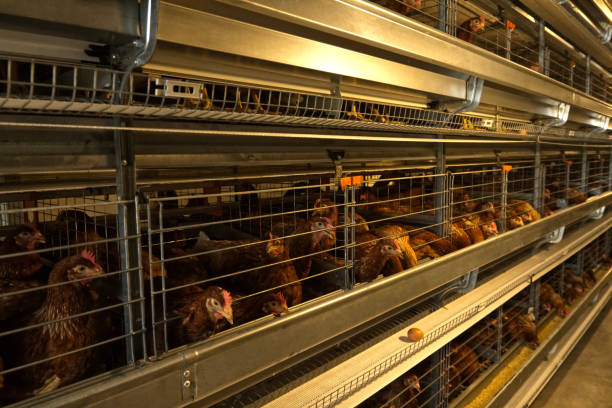
Layer Cage for 30,000 Layers in Nigeria: H Type Poultry Farm Solution
For a commercial poultry investor planning to raise 30,000 laying hens in Nigeria, choosing the right layer cage system is one of the most important decisions at the beginning of the project. Cage capacity, poultry house layout, feeding efficiency, manure removal, egg collection, ventilation, and future expansion all affect the long-term operation of the farm.
For this production scale, an H type layer cage system can provide a practical solution for increasing stocking capacity while introducing a higher level of automation.
LIVI Machinery provides H type layer cage systems and supporting poultry equipment for commercial layer farms. For a 30,000-layer project in Nigeria, the cage system can be planned together with the poultry house dimensions and automatic equipment instead of purchasing each component separately.
Why Consider an H Type Layer Cage for 30,000 Chickens?
A farm with 30,000 laying hens is already a commercial-scale operation. At this capacity, relying heavily on manual feeding, manure cleaning, and egg handling can increase daily labor requirements and make farm management more complicated.
An H type layer cage arranges birds vertically in multiple tiers, allowing farmers to accommodate a large number of layers within the available poultry house space.
The LIVI H type layer chicken cage system can integrate:
- H type layer chicken cages
- Automatic feeding system
- Automatic drinking system
- Automatic manure removal system
- Automatic egg collection system
- Ventilation and environmental control equipment
This integrated approach is particularly useful when the objective is not simply to purchase cages, but to build an efficient 30,000-bird commercial egg farm.
How Can 30,000 Layers Be Arranged in H Type Cages?
There is no single cage layout that should automatically be applied to every 30,000-layer farm.
The final configuration depends on factors such as poultry house length and width, selected number of cage tiers, aisle arrangement, equipment layout, ventilation design, and the required operating space.
LIVI H type layer cages are available in multiple-tier configurations. Different configurations provide different bird capacities per cage unit and can be selected according to the required stocking capacity and poultry house conditions.
For a Nigerian farm targeting approximately 30,000 laying hens, LIVI can calculate the required cage rows and units after confirming the farm conditions.
This is why buyers should avoid selecting a layer cage for 30,000 chickens based only on the advertised capacity of an individual cage unit. The complete poultry house layout should be considered at the same time.
Farm owners who are still comparing equipment configurations can first review the LIVI H type layer cage and then provide their house dimensions for a project-specific layout.
Key Equipment for a 30,000-Layer Poultry Farm
1. H Type Layer Cage System
The cage system forms the core of the project.
LIVI H type cages use a multi-tier structure designed for intensive commercial layer production. For a 30,000-bird project, this vertical arrangement helps make better use of available poultry house space.
Farm investors can review the H type layer cage system when evaluating cage configurations for their project.
2. Automatic Feeding System
Feeding 30,000 birds consistently is difficult to manage efficiently with manual labor alone.
An automatic feeding system distributes feed along the cage rows, reducing repetitive manual work and helping maintain more consistent feed distribution.
For investors comparing layer cage systems in Nigeria, feed handling deserves particular attention because feed management directly affects the daily operation of a commercial layer farm.
3. Automatic Drinking System
Layers require continuous access to drinking water.
The H type cage system can be equipped with an automatic drinking system so water is supplied directly along the cage rows.
When planning a project, the water source, storage capacity, pipe arrangement, and daily farm requirements should therefore be considered together with the cage equipment.
4. Automatic Manure Removal
Manure management becomes increasingly important as bird numbers increase.
In an H type layer cage house, manure belts can remove manure from different cage tiers instead of allowing large quantities of manure to accumulate below the birds.
For a 30,000-layer farm, this can reduce manual manure handling and support more organized daily farm management.
The manure discharge area outside the poultry house should also be included in the farm layout from the beginning.
5. Automatic Egg Collection
With thousands of laying hens producing eggs every day, egg handling can become another major labor requirement.
An automatic egg collection system transports eggs from the cage rows toward a centralized collection point.
This can make egg handling more organized and reduce dependence on workers collecting eggs cage by cage.
For investors seeking a more automated solution, these systems can be planned together with the H type layer chicken cage according to the required farm capacity.
Ventilation Is Important for Layer Farms in Nigeria
Buying a good layer cage is only part of building a successful poultry house.
Nigeria’s warm climatic conditions make poultry house ventilation and environmental management an important part of project planning. As stocking density increases, heat, moisture, manure gases, and airflow must be managed carefully.
For a high-density H type cage house, ventilation equipment should therefore be selected according to the poultry house design and local project conditions.
Depending on the farm design, the complete solution may include ventilation fans, air inlets, cooling equipment, and related environmental control equipment.
Important factors include:
- Poultry house dimensions
- Number and arrangement of cage rows
- Number of cage tiers
- Local climatic conditions
- Planned stocking capacity
- Open-house or closed-house design
This helps match the environmental control system to the actual 30,000-layer project.
H Type vs. A Type Layer Cage for a 30,000-Bird Farm
Both A type and H type layer cages can be used for commercial egg production, but they suit different project priorities.
A type cages are often considered where investors prefer a relatively simpler system or have lower automation requirements.
H type cages are particularly attractive when the objective is higher stocking density and greater automation. Multiple cage tiers make better use of vertical space, while feeding, drinking, manure removal, and egg collection can be integrated into the production line.
For a 30,000-layer poultry farm, an H type layer cage may be suitable when the investor wants to:
- Increase bird capacity within available poultry house space
- Reduce repetitive manual work
- Introduce automatic manure removal
- Automate egg collection
- Build a more standardized commercial production system
- Leave room for future farm expansion
The appropriate choice should ultimately be based on available land, poultry house design, investment plan, labor conditions, and desired automation level.
What Determines the Price of a Layer Cage in Nigeria?
A common question from buyers is: How much does a layer cage for 30,000 chickens cost in Nigeria?
There is no reliable single price without defining the project configuration.
The quotation can vary according to:
- Total number of laying hens
- H type cage model and number of tiers
- Number and dimensions of poultry houses
- Feeding automation
- Manure removal configuration
- Egg collection requirements
- Drinking system
- Ventilation and environmental control requirements
- Shipping and project location
- Installation and other project-specific requirements
Therefore, comparing quotations only by the price of the cage itself can be misleading.
A better comparison is to determine exactly what equipment is included and whether the proposed system is properly sized for 30,000 birds.
If you are evaluating the layer cage price in Nigeria, review the H type layer cage system and request a configuration based on your actual bird capacity and poultry house dimensions.
Information Needed for a 30,000-Layer Cage Quotation
If you are planning a poultry project in Nigeria, providing several basic details will make it easier to prepare a suitable equipment configuration.
Please provide:
- Country: Nigeria
- Bird type: Laying hens
- Planned capacity: About 30,000 birds
- Preferred system: H type layer cage
- Existing poultry house dimensions, if already built
- Available land dimensions, if the houses have not yet been constructed
- Required automation level
- Any plans for future expansion
If the poultry houses have not yet been built, planning the cage arrangement before finalizing the house dimensions can help avoid situations where the building and equipment layouts do not match.
Frequently Asked Questions About Layer Cages in Nigeria
What type of layer cage is suitable for 30,000 chickens?
An H type layer cage is a practical option for a 30,000-layer commercial farm because it provides high stocking density and can integrate multiple automatic systems.
How many layer cages do I need for 30,000 chickens?
It depends on the cage model, number of tiers, and capacity per unit. LIVI can calculate the required cage quantity after confirming your poultry house dimensions.
How much does a layer cage cost in Nigeria?
The price depends on cage capacity, automation level, poultry house layout, supporting equipment, and shipping destination. A project-specific quotation is recommended.
Can H type layer cages be used in Nigeria?
Yes. H type cages can be used for commercial layer farms in Nigeria when the poultry house, ventilation, and environmental control systems are properly planned.
What equipment is needed for a 30,000-layer farm?
A typical system can include H type cages, automatic feeding, drinking, manure removal, egg collection, and ventilation equipment.
Should I build the poultry house before ordering cages?
It is better to plan the cage layout before finalizing a new poultry house. If the house is already built, provide its length, width, and height for equipment layout planning.
Can LIVI customize the cage system for my farm?
Yes. LIVI can recommend an H type layer cage configuration based on bird capacity, poultry house dimensions, available land, and automation requirements.
What information is needed to get a quotation?
Provide your country, number of birds, poultry house or land dimensions, preferred cage type, and required automatic systems.
Get a Customized 30,000-Layer Cage Solution from LIVI Machinery
A 30,000-layer poultry farm should be designed as a complete production system rather than simply as a collection of chicken cages.
LIVI Machinery can provide a customized H type layer cage solution based on your farm capacity, poultry house dimensions, available land, and automation requirements. The equipment solution can cover cages as well as feeding, drinking, manure removal, egg collection, ventilation, and related poultry farm systems.
If you are preparing to start or expand a 30,000-layer poultry farm in Nigeria, submit your project requirements to LIVI Machinery.
Tell us:
How many chickens do you plan to raise?
Have you already built the poultry house?
What are the house or available land dimensions?
Which automatic systems do you need?
Our team can use this information to recommend a suitable cage configuration, prepare the poultry equipment layout, and provide a project quotation for your farm.
Contact LIVI Machinery for a customized 30,000-layer H type cage solution and project quotation.